How to actually get your business found on Google in 2026
ContentsMenu
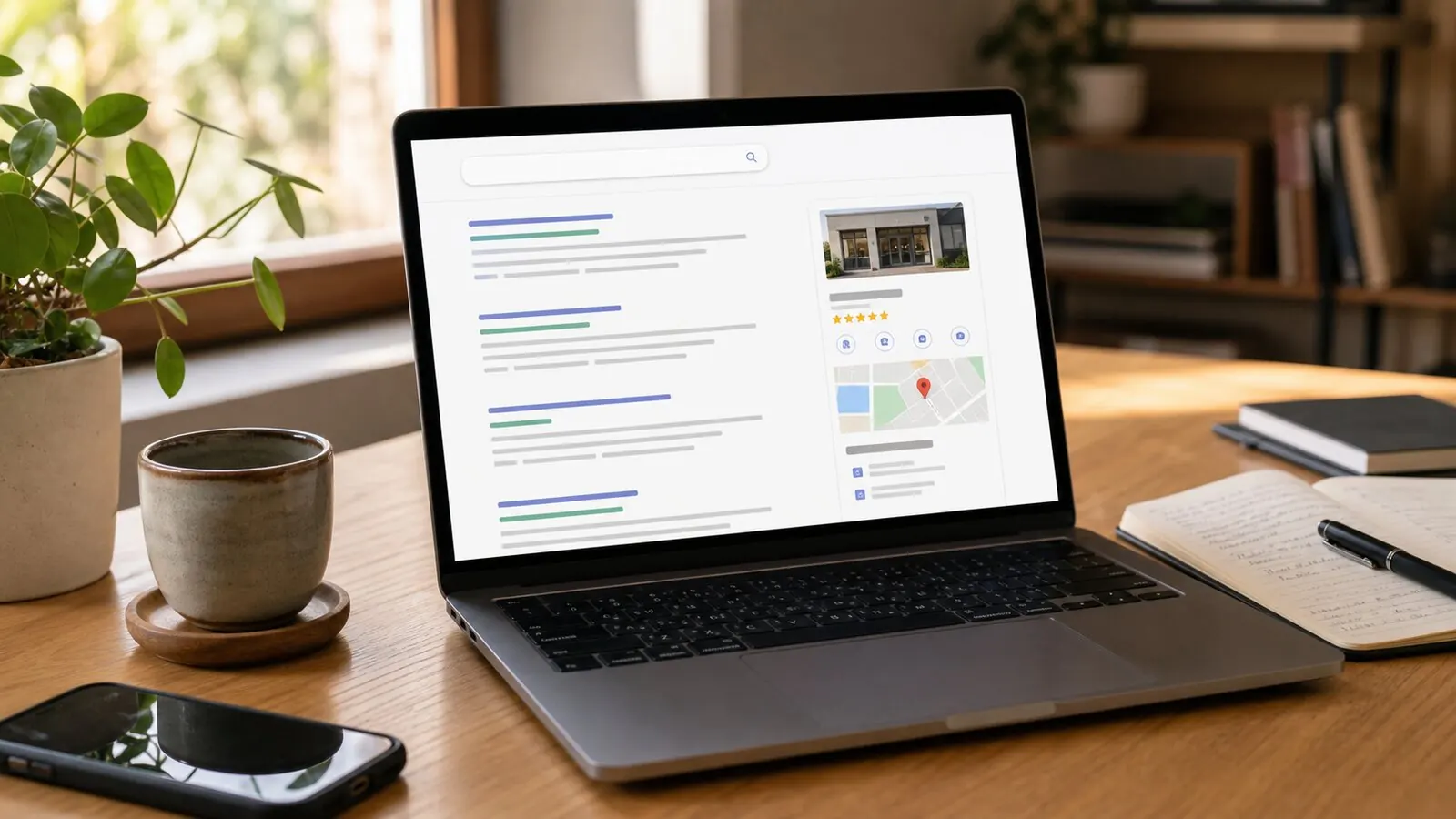
Open Google. Type your business name. Hit search.
What did you see?
If you saw your competitor, congratulations, you just lost a customer in real time. Someone was about to find you, forgot the exact spelling, typed something close, and Google decided someone else was the better answer.
This happens every single day to small businesses that have not been told that being on Google is not the same as being findable on Google. They are completely different things. The gap between them is what separates businesses that get a steady stream of new customers from the ones who are always wondering where the next sale will come from.
Good news. The list of things that actually make Google show your business is shorter than people pretend. Most SEO advice online is written by people trying to sell you a tool, a course, or an agency. They will list 47 things you need to do. You do not need 47 things. You need about five.
Here are the five.
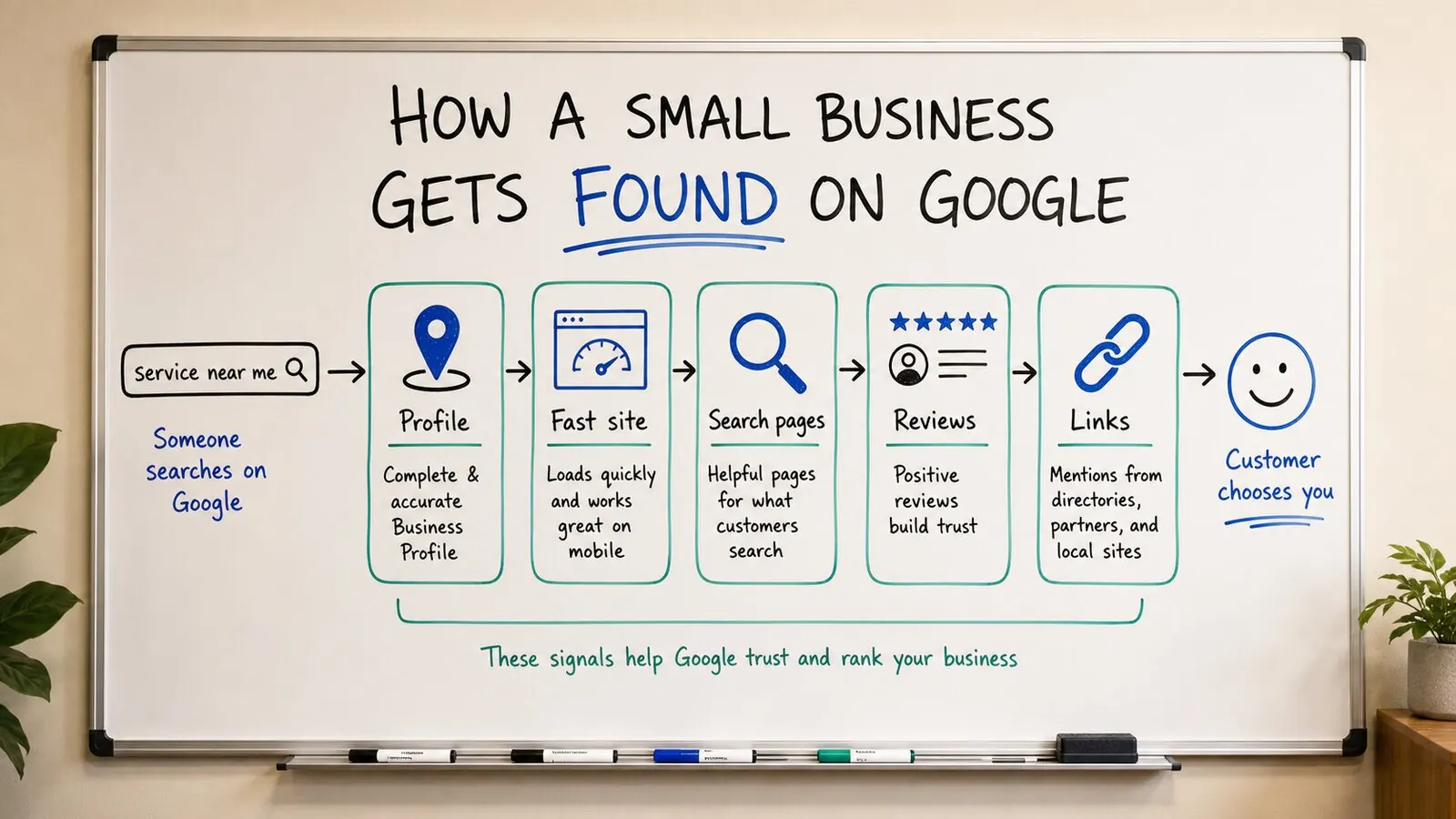
One. Set up Google Business Profile properly
If you serve customers in a place (a shop, an office, a service area), this is the highest impact thing you can do. It is also free.
Google Business Profile is the listing that shows up in the map, the local pack, and the right side panel of search results. It is what shows up when someone Googles "barber near me" or "web developer in Lagos" or "bakery open now".
A small business with a polished Business Profile will outrank a much bigger business with a weak one, every time. The bigger business has a fancier website, more marketing money, and a brand name. The smaller business has 12 photos, 23 real reviews, accurate hours, and a clear service list. Google sides with the smaller business, because that is what searchers actually click on.
Setup takes about 20 minutes plus verification (which can take a few days). Claim your listing at google.com/business, verify ownership, add 10+ photos, list your services with prices, set hours, and ask happy customers for reviews.
If you only do one thing from this whole post, do this one.
Two. Make your website fast and clear
Google has been telling people for years that fast websites rank higher. They were not joking. In 2026 it is stricter.
If your site takes more than three seconds to load, Google quietly bumps it down. If it takes more than five, Google sends most of your potential visitors away before they even see your page. There is a chart somewhere inside Google that shows how many people bounce based on load time, and it is brutal. Your beautiful landing page does not matter if half the people who clicked never saw it.
The same goes for clarity. Google reads your pages like a smart but impatient human. If the page is full of buzzwords, ten different headlines, and four buttons fighting each other, Google does not know what your page is about. So it ranks you for nothing.
The fix is not complicated. One clear thing per page. Headline says what you do. Subheadline says who it is for. The rest of the page proves it. Page loads in under three seconds. Done.
This is where templates and drag and drop builders fall apart. They look fine but they ship with massive amounts of unused code that crushes load times. If your site was built on one of these and is not ranking, the site itself is probably the reason.
Three. Write pages for what people search, not what you do
This is the mistake almost every small business makes. They have a page called "Our Services" that lists everything they do in their own internal language.
A bakery has a page that says "custom cakes, pastries, breads, special orders, events".
Nobody types that into Google. People type "wedding cakes in Lagos" or "best birthday cake delivery" or "how much does a wedding cake cost". Those are the searches the bakery wants to show up for. But its services page does not say any of those words.
The fix is to have one focused page for each thing people search for. Not one giant page that mentions everything. One page per search.
So the bakery would have a wedding cakes page with photos, prices, and a contact form. A birthday cakes page with photos, prices, and how to order. A delivery page that says where they deliver and what it costs.
Each page targets exactly one thing people search for. Google now has three clear chances to match the bakery to a customer instead of one fuzzy chance. Same business. Same products. Three times the search exposure.
If you do not know what to write, look at what people actually type. Google has a free tool called Keyword Planner. You can also just scroll the "People also ask" boxes inside search results. Those are real questions from real customers.
Four. Get real reviews on Google
A business with 30 real Google reviews ranks above a business with zero reviews almost every time, even if the second one has a better website.
Google trusts other humans more than it trusts you. That sounds obvious but most businesses act like it is not true. They spend a year building a fancy site and never once ask their happy customers to leave a Google review.
The fix is to make asking part of how you work. After every paid job, send the customer a direct Google review link with a one line message. Something like "if you have a minute, a quick review would help us a lot". About one in three people will actually do it.
The first five reviews are the hardest. After that it gets much easier because new customers can see other people trusting you. Reviews compound.
One warning: do not pay for fake reviews. Google can detect them now and the penalty is removing your profile from search results entirely. People have lost businesses this way. Just ask real customers. It works.
Five. Get linked to from other real websites
When another website links to yours, Google reads that as a vote. The more votes from trustworthy sites, the more Google trusts you.
You do not need to chase this. You need to do things that earn links naturally. The short list:
Be quoted in articles. Reach out to local journalists or bloggers in your niche. Sponsor something local; many event sites link sponsors. Get listed in real local directories, like your city's chamber of commerce, not random link farms. And write actually useful content, because blogs that answer real questions get linked to by other blogs over time.
That last one is the slow burn version of SEO. A single blog post that genuinely answers a question your customers are asking can pull in traffic for years. Many of those readers will become customers. Some will link to you.
The stuff to ignore
Now the relieving part. Here is what you can safely ignore even though SEO blogs will tell you they are critical.
Schema markup, sitemaps, robots.txt, and all the other technical stuff. If your site was built by a real developer in the last two years, this is already handled. If it was not, your developer should handle it once and never bring it up again.
Keyword density. That was a thing in 2008. It is not anymore. Just write naturally.
Meta descriptions for every page. Google often rewrites them anyway. Write good ones for your most important pages and stop worrying about the rest.
SEO plugins that promise miracles. None of them work. The good ones just help you do the basics. The bad ones add bloat that slows your site down.
Posting fresh content every week. This works for blogs that are already big. For a small business it is wasted effort. One excellent post per month beats four mediocre posts per week.
What to actually do this month
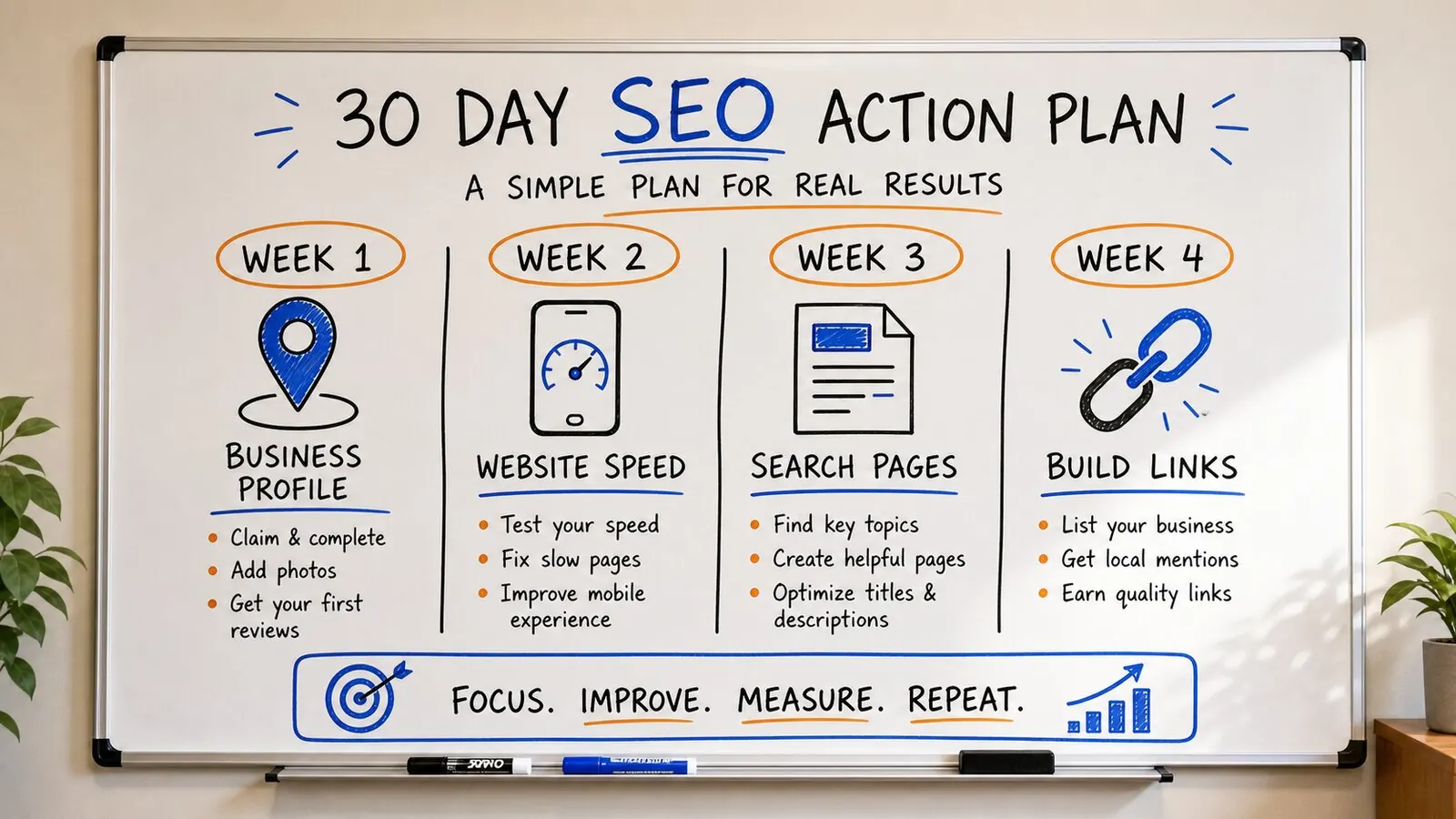
If you have time and budget for one thing, set up your Google Business Profile and ask your five best past customers for reviews. That is your week one move.
Week two, look at your website on your phone. Time the load. Read the homepage out loud. If anything feels slow or confusing, fix it or get it fixed.
Week three, write down the five things people actually Google before they hire someone like you. Make sure your site has a clear page for each of those things.
Week four, find one real local site or directory that should be linking to you. Reach out. One link is enough this month.
Do this for three months and you will rank for things you do not currently rank for. You will get calls and DMs from people who Googled their way to you. The first time someone says "I found you on Google", you will understand why we wrote this post.
If you want help with any of this, book a call. We do free 20 minute audits where we look at your current Google presence, tell you what is working, what is broken, and what to fix first. No sales pressure. We turn down projects that are not a fit.
The next person Googling your service is looking right now. The only question is whether they find you or someone else.
Want us to build something for you? Contact the team.