How to add AI to your business without burning money in 2026
ContentsMenu

Let me start with something I have to say out loud because everyone else seems afraid to.
You probably do not need AI in your business.
Not because AI is not useful. It is incredibly useful. But because most of the businesses asking for AI in 2026 do not have the actual problem AI solves. They have a regular problem. They got told by an investor, a consultant, a YouTube video, or a competitor's announcement that the answer is AI.
The answer is usually something cheaper, faster, and more boring.
If you are reading this because you are wondering whether you should add AI to your business, this post is for you. By the end you will know whether you actually need it. If you do, you will know how to start small and not waste money. If you do not, you will save the money and use it on something that actually moves the needle.
The wrong reasons to add AI
Let me list the reasons people come to me wanting AI that almost never turn into a good project.
"Our investors want us to have AI." Investors are following trends. Trends are not your customers. If your customers do not care, the AI feature is theater. You spend money building something that nobody asked for. The investors are happy for one quarter. Then they want the next thing.
"Our competitor announced an AI feature." Your competitor may know something. Or they may also be doing it because their investors told them to. Look at whether their feature actually got used by their customers before you copy it. Most AI features at most companies are press releases, not products.
"We have to do something with AI before we get left behind." This is the version that scares me the most. It is fear talking, not strategy. Fear projects ship slow, cost too much, and rarely make money back.
"We have so much data, we should do something with it." Having data is not the same as having a use for it. AI does not turn data into money on its own. You need a clear question, a clear answer, and a clear action you would take based on that answer. Without those, you are just paying for hallucinations.
If any of these are the reason you want AI, stop. Spend the money on something else. There are better problems to solve.
The right reasons to add AI
Here is when adding AI actually makes sense.
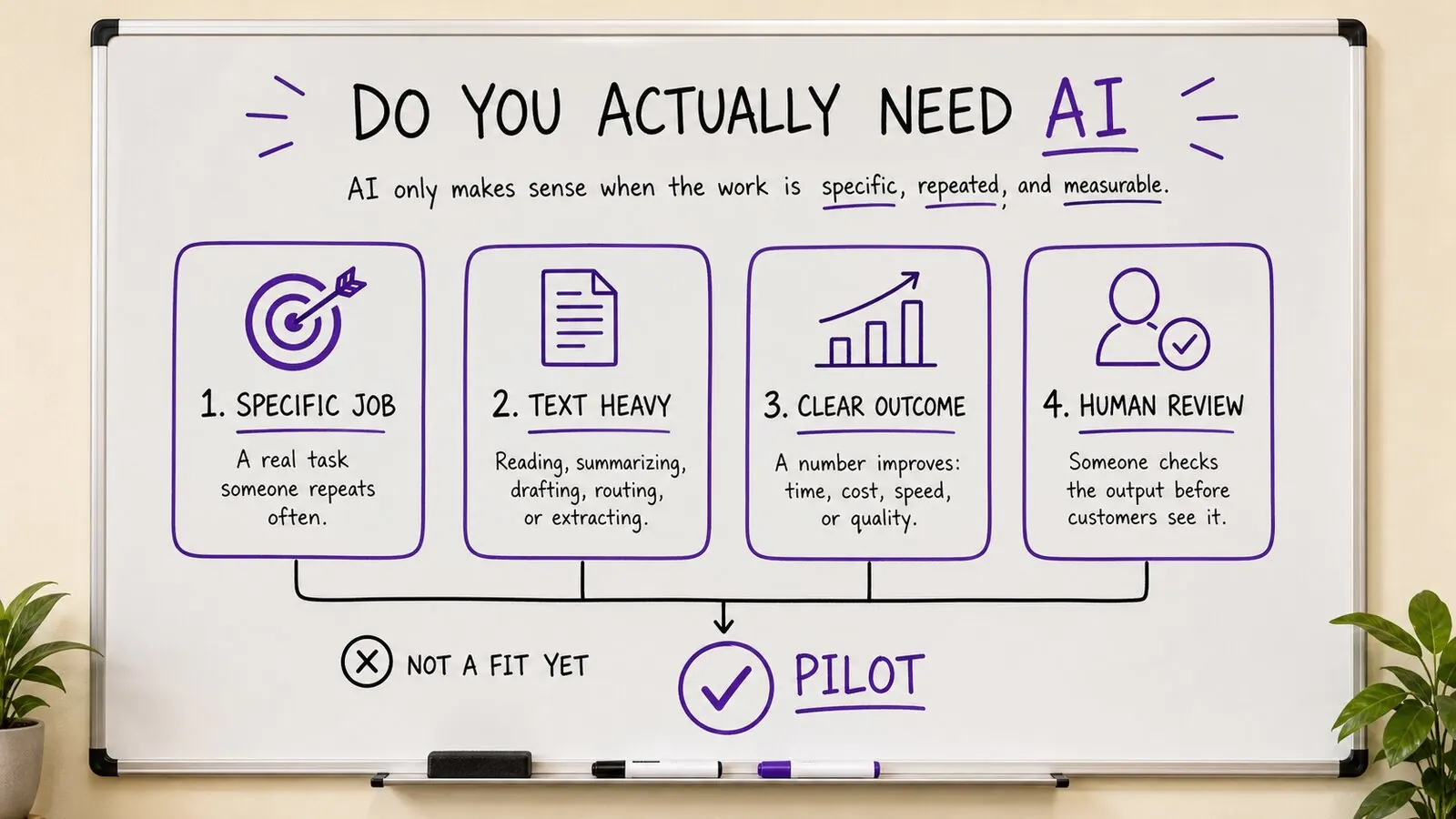
You have a specific job that someone is doing repetitively. A customer support team that answers the same 30 questions every day. An analyst who pulls the same report every Monday. A sales rep who writes the same kind of email twenty times a week. AI is genuinely good at being the first draft for repetitive work, then a human polishes it. You save real hours.
You have a clear, measurable outcome you care about. "Reduce support response time from 8 hours to 30 minutes" is a real goal. "Use AI to be more efficient" is not. If you cannot put a number on the outcome, the project does not have an end. It does not have a price either.
The job currently requires reading a lot of text or generating a lot of text. AI is best at text in, text out. Summarizing documents. Drafting emails. Pulling information out of long meetings. Answering questions about a knowledge base. If the work is mostly numbers, mostly images, or mostly clicks, AI is often the wrong tool.
You are willing to put a human in the loop. AI in 2026 still gets things wrong. Not catastrophically wrong all the time, but wrong enough that you need a human checking the output before it goes to customers. If you cannot do that, you should not ship the feature.
If all four are true, AI is probably a real fit. Talk to someone. Get a quote. Run a pilot.
Five ways small businesses are using AI well right now
These are real examples I have seen work, not theory.
One. Drafting customer support replies. Your team gets the same kinds of tickets every day. AI reads the ticket, drafts a reply based on your knowledge base, your team reviews and sends. The team handles 3x the tickets without burning out. Cost to build is a few thousand dollars. Pays back in weeks.
Two. Categorizing leads automatically. A form comes in through your website. AI reads it, scores how qualified the lead is based on your historical data, routes it to the right person on your team. Your sales team stops wasting time on bad fits.
Three. Searching across your own documents. Your team has years of project docs, meeting notes, and internal wikis. Finding anything is impossible. AI lets you ask in plain English and get the answer with a citation. This one alone has paid for itself for several of our clients.
Four. Translating product descriptions. If you sell to multiple regions, AI can produce decent translations for hundreds of products in hours instead of paying for human translation. You still want a human to review the important pages, but the long tail of "the 800 product descriptions nobody reads in detail" is fine for AI to handle.
Five. Generating first drafts of social posts, blog posts, or email campaigns. Not the final version. The first version that you edit. This one is unglamorous but real. Saves your marketing person an hour a day.
Notice what is missing from this list. There is no "build an AI agent that runs my whole business" or "use AI to replace customer service entirely" or "let AI write our blog with no review". Those things sound impressive in a pitch. They blow up in practice.
How to start small and not waste money
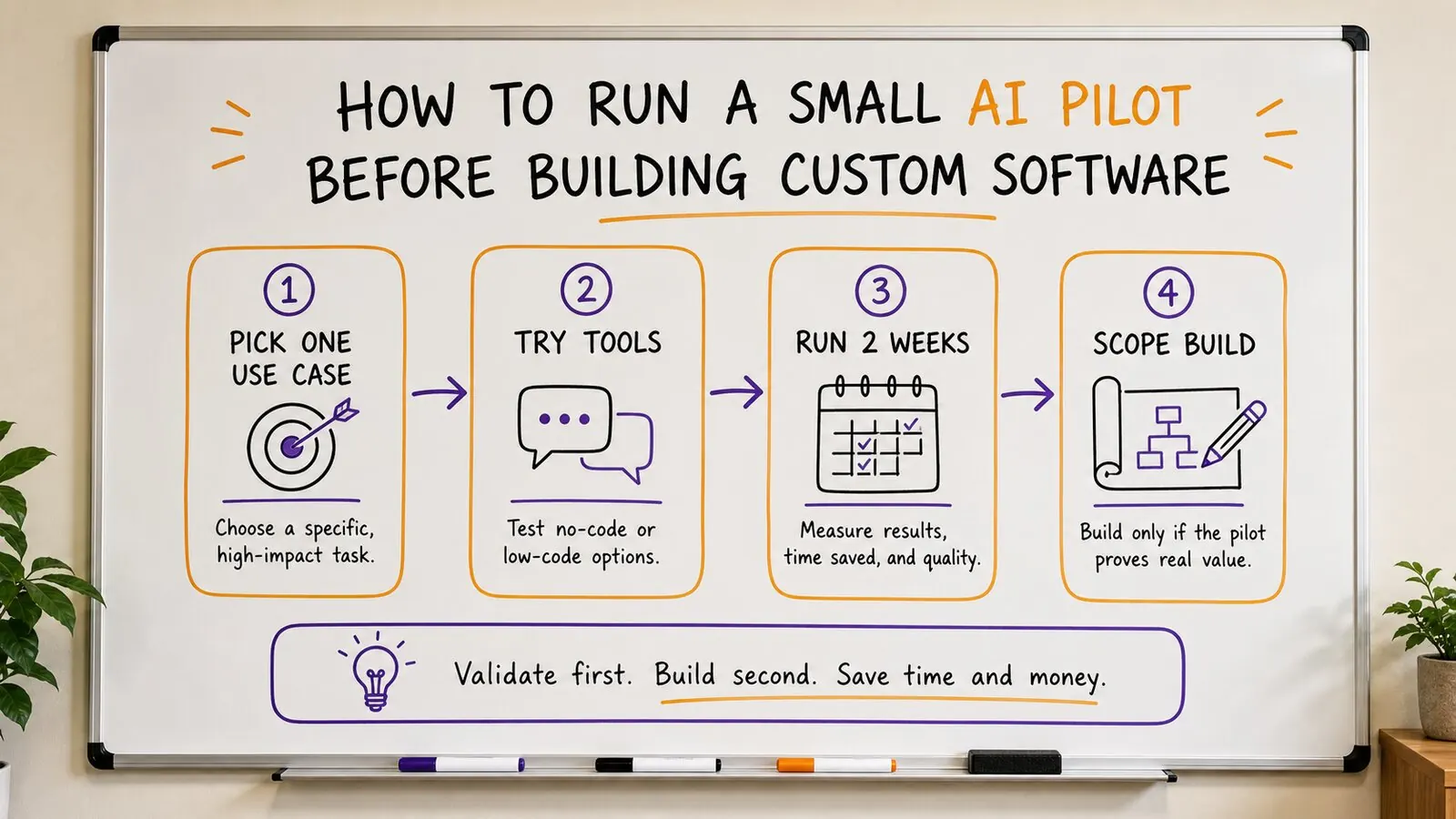
If you decided you do want to add AI to your business, here is how to do it without burning a budget.
Pick one specific use case. Not three. Not "let us explore AI". One. Pick the use case where the boring version is genuinely not good enough or where the time saved is large and obvious. Write down what success looks like in one sentence.
Use the off the shelf tools first. Before you pay anyone to build you anything, try Claude, ChatGPT, or Perplexity yourself, by hand, on the actual problem. If you cannot get to a useful result with those tools, building a custom version probably will not help either. You need to know that the underlying model can do the job before you wrap a product around it.
Run a pilot with one person on your team for two weeks. Have them use the off the shelf tool on the real workflow. Track how much time it saved them. Track how many times the output was good enough to use as is, how many times it needed editing, and how many times it was just wrong. This gives you real numbers, not guesses.
Only then talk to a developer about building the custom version. With the pilot data in hand, a good developer can scope the project in days, not weeks. You know what the feature has to do because you watched a human do it for two weeks.
Budget for the wrongness. AI gets things wrong. Plan for it. The cost of a wrong AI answer is what determines whether you can deploy without a human reviewer. For low cost mistakes, AI alone is fine. For high cost mistakes, you keep the human in the loop. Forever.
Red flags when someone pitches you AI
Watch for these when you talk to anyone who is selling AI services.
They cannot tell you what specific problem the AI solves for your business. They show you a demo with someone else's data and call it a fit.
They promise outcomes without numbers. "AI will make you more efficient" is not an outcome. "AI will reduce support response time by 60 percent based on our pilot data" is an outcome.
They say "we cannot show you the prompt, it is proprietary". Run.
They want six figures upfront before showing you a working demo on your data. Run faster.
They do not mention human review of the output at all. They are selling you a feature that will break in production and they are not planning for it.
What to do next
If you are still not sure whether AI fits your business, that is the right place to be. Do not buy anything yet.
Book a 20 minute discovery call with us. Tell us the problem you are trying to solve. We will tell you whether AI is the right answer. If it is, we will tell you the smallest possible version that proves the point. If it is not, we will tell you what to do instead.
We turn down AI projects almost every week because they do not pass our own checklist. Better to lose the project than build something that does not work.
The best money you spend on AI in 2026 is the money you do not spend on AI you do not need.
Want us to build something for you? Contact the team.