Why your website has traffic but no sales (the 7 real reasons)
ContentsMenu
You looked at your Google Analytics. The number of people visiting your site went up. You expected sales to go up too. They did not.
This is one of the most common, most frustrating problems in business. Traffic without sales feels like having a busy store where every person walks in, looks around, and walks out without buying anything.
Here is the thing nobody tells you. The product is almost never the problem.
I have seen this happen with great products. Beautiful products. Products that people actually want. The traffic shows up, the cart stays empty, and the founder starts wondering if the whole thing was a mistake.
It is not. It is one of the seven things below. I am going to walk through each one in order of how often I see it, with what to actually do about it.
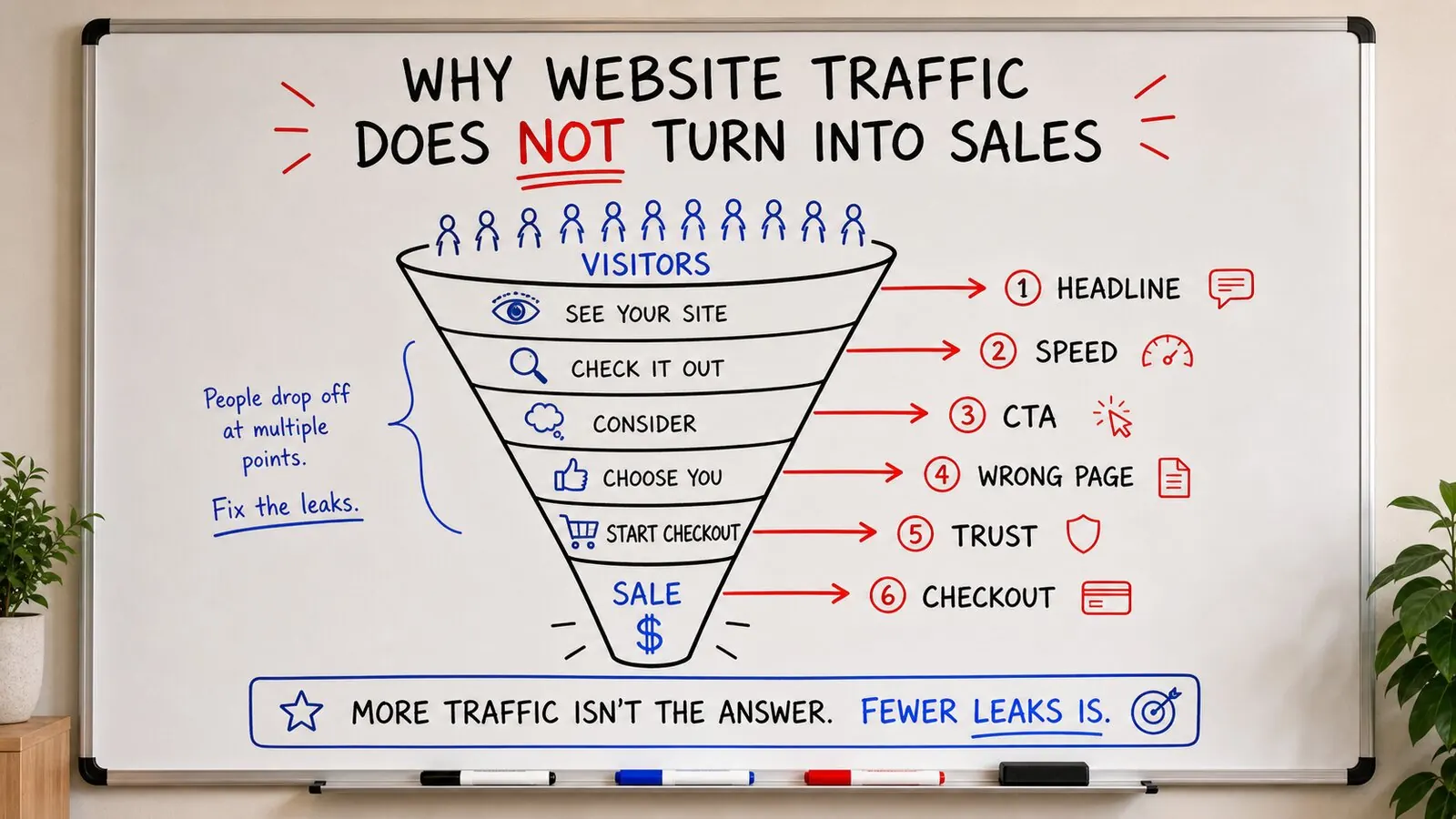
Reason 1. Your headline does not say what you sell
This is the biggest one. By a mile.
Someone lands on your homepage. They have about three seconds to figure out what your business does and whether it is for them. If the headline at the top of the page is some clever slogan that does not name your product or your service, they leave.
I am going to give you a real test. Open your website right now. Look at the first thing a visitor sees. Read it out loud.
Does a stranger now know:
- What you sell
- Who it is for
- What is good about it
If they would not know all three from your headline plus the line under it, your headline is failing.
This is by far the cheapest problem to fix. You do not need to rebuild the site. You need to rewrite ten words at the top. Replace "Where dreams become reality" with "Custom wedding cakes for couples in Lagos." Replace "Innovating tomorrow's solutions today" with "We build websites for small businesses. Done in four weeks."
Clear beats clever. Always.
Reason 2. Your site is slow
This one is invisible to you because your browser cached your site five minutes after you built it. It is not invisible to a first time visitor on a phone with a regular internet connection.
If your site takes more than three seconds to load, you are losing roughly half your visitors before they see anything. They tapped a link, the screen stayed white, they got bored, they tapped back. The visit shows up in your analytics. The sale does not.
To check this honestly, open your site in a fresh incognito window. On your phone. On wifi that is not the office. Time how long until you can actually read the first headline.
If it is more than three seconds, this is your first fix. Slow sites usually come from one of four things. Big unoptimized images. Too many third party scripts loaded on page load. A bloated template with code you do not use. A cheap hosting plan that throttles your traffic.
Fixing this is usually a few hours of work. The conversion bump is often double digits.
Reason 3. Your call to action is hidden or unclear
A visitor decided they want what you sell. Great. Now what?
If they have to scroll for an answer, look at three different sections, or guess what the next step is, you lost them. People who are ready to buy will not work to find the buy button. They will just leave and try a competitor.
Open your site again. Look at the first screen. Count the actions you are asking the visitor to take. If there are more than two, you have too many. One primary action, like "Book a call" or "Buy now" or "Get a quote". Maybe one secondary action like "See examples" or "Learn more". That is it.
The primary action should be a button. The button should look like a button. It should say what happens when you click it. "Submit" is bad. "Book my discovery call" is good. "Start free trial" is good. "Add to cart" is good.
If you have a button that says "Learn more", what does the visitor learn? Where do they go? Usually nowhere useful. Replace it with the actual action.
Reason 4. People are landing on the wrong page
This is the sneaky one. You set up Google Ads or boosted a post on Instagram. The campaign drives traffic. But that traffic lands on your homepage, which is built for someone who already knows who you are.
The visitor came in looking for one specific thing. Your homepage shows them everything. They get overwhelmed. They leave.
If you are running paid traffic to any campaign, that traffic should land on a page built specifically for what the campaign promised. If the ad says "Get a free quote for a website", the landing page should say "Get a free quote for a website" at the top, have one field for email, and one button to submit. Nothing else.
Sending all paid traffic to your homepage is one of the most expensive mistakes small businesses make. Build dedicated landing pages for your top three campaigns. Sales will jump.
Reason 5. Trust signals are missing
Imagine you are about to spend money with a business you have never heard of. What makes you trust them?
Reviews from real people. Photos of real work. Names and faces of the team. A real address. A real phone number. Logos of clients or press they have been in. A clear policy if you change your mind.
Now check your site. How much of that is there?
A lot of small business sites are missing most of this. The site looks fine, the product looks fine, but a stranger has no reason to believe you. They go look at a competitor who has 47 reviews on Google and a friendly photo of their team. They buy from the competitor.
You do not need all of this on day one. You need at least three of these things visible above the fold. Reviews are the highest impact one. If you have happy customers, get them to leave a Google or a testimonial. Put the best ones on your site with the customer's first name and photo if they will let you.
Reason 6. Mobile is broken
Most of your traffic in 2026 is on a phone. Probably 65 to 80 percent.
The site you built on your laptop probably works fine on a laptop. The site on a phone is a different story. Buttons are too small. Text overflows. The cart sticks to the bottom and covers the price. The form takes thirty seconds to fill out because every tap zooms the screen weirdly.
Open your site on your phone. Try to do the thing a customer would do. If you are an ecommerce site, try to buy something. If you are a service business, try to book a call.
Pay attention to every moment of friction. Every place where you had to pinch to zoom or scroll sideways or guess where to tap. Each one of those is costing you sales.
Mobile design is not just "shrink the desktop site". It is a different layout. Forms should be bigger. Buttons should be thumb sized. The most important action should be in reach without scrolling.
Reason 7. Friction at checkout
This one is for ecommerce specifically. If you are running an online store and people are adding to cart but not buying, the issue is in your checkout.
I have watched real users try to buy things on real Nigerian and international ecommerce sites. The number of carts I have seen abandoned because of checkout friction is heartbreaking. Common reasons.
The checkout asks for too much information. Phone number, full address, billing address, billing zip, account password, marketing consent, security questions. Ten fields. The customer just wanted a t shirt. They give up.
Account required to check out. Guest checkout is missing. The customer is not in the mood to create an account for one purchase. They leave.
Payment methods are limited. You take Stripe in USD, but your customer is in Nigeria and wants to pay with Paystack or Flutterwave. Or vice versa. They cannot complete the transaction.
Shipping cost reveals at the last step. The customer is excited, they get to the final screen, they see shipping doubles the price, they leave. Always show shipping cost early.
Fix the checkout, sales come back. This is often the single highest impact change you can make to an ecommerce site.
How to actually fix this
If you read this post and recognized your own site in two or three of the reasons, that is normal. Most sites have at least three of these problems at once.
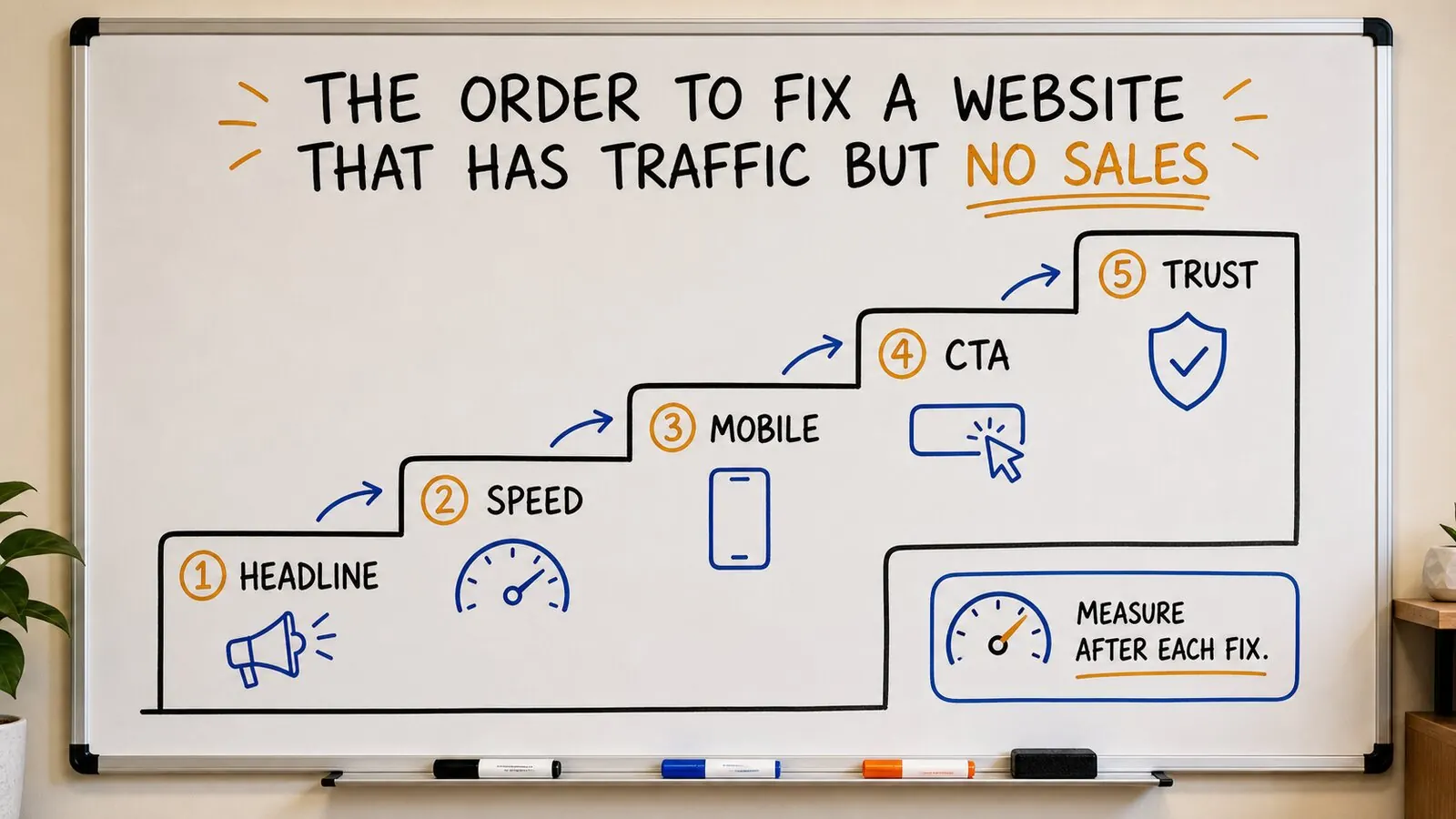
The fix order matters. Start with the cheap, fast wins.
Fix the headline first. It costs nothing and takes an hour. The impact is usually immediate.
Test your speed and mobile experience. If either is broken, fix that next. Speed and mobile are foundational. Everything else assumes those are working.
Then look at your checkout if you are ecommerce, or your booking flow if you are a service business. This is where the actual transaction happens. If this is broken, nothing else matters.
Then trust signals. Reviews, team photos, real contact info. Add these last because they take some time to gather.
If you go through this list and you still cannot tell what is wrong, that is what we do. We audit websites for conversion problems. Twenty minute call, we look at your real site, we tell you the top three issues.
Book the call. It does not cost anything. You walk away knowing what to fix even if you never hire us to fix it.
The traffic showing up at your site is not random. It is people who already considered buying from you. The question is whether you give them the path or block it.
Want us to build something for you? Contact the team.